Data Centers in Erie
A fully fact-checked briefing on what a data center would actually mean for Erie. No position for or against. As of June 2026, no project has been proposed in Erie County. Covers the real tax number ($0.8 to 4.7 million a year, not the billion-dollar headline), who pays for the power, the water math, the noise rules, and the guardrails Erie County and Harborcreek already wrote.
Erie County SALDO, Harborcreek ordinance, PA PUC large-load tariff, PJM, Governor's GRID Standards, June 2026
Millcreek Township Transition Plan
Millcreek voted to switch from three supervisors to a five-member council plus professional manager. This 34-page plan covers the administrative code, staffing, budgets, public works, parks, police, fire, timeline, employee FAQ, and risk register.
GSC Final Report, Optional Plans Law, DCED, comparable municipality research
Millcreek Council-Manager Transition: Committee Briefing
Briefing document for the Government Transition Advisory Committee. Covers the six deliverables before January 3, 2028, the 325 Board of Supervisors references that must be reassigned, the Administrative Code that must be built, and word-for-word working models from College Township and Indiana Township. Effective date: January 3, 2028.
Codified Millcreek Township Code, GSC Final Report, 53 Pa.C.S. Ch. 30 Optional Plans Law, College Township and Indiana Township ordinances
Erie County Reassessment Estimator
54% of Erie homeowners would pay less under a fair reassessment. Look up your address and see what your property tax bill would look like if Erie County reassessed to current market values.
Erie County Assessment Bureau, PA STEB, Recorder of Deeds sales data
Where Your Property Tax Dollar Goes
You pay $1.00 in property tax. 34.5 cents goes to the city. 17 cents to the county. 48.5 cents to the school district. Updated with Erie County Council budget analysis showing what your property tax dollar actually funds vs what state and federal money covers.
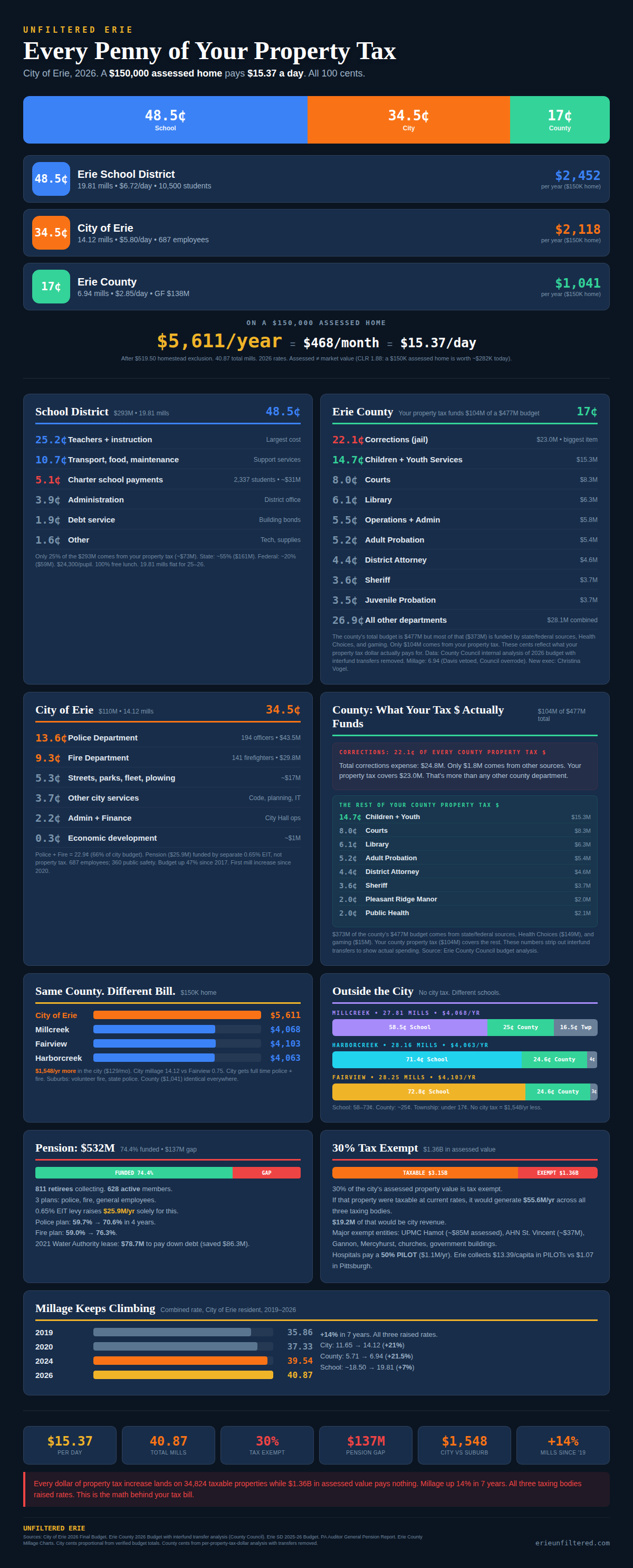
City of Erie 2026 Budget. Erie County 2026 Budget. Erie SD 2025-26 Budget.
Why Do My Property Taxes Keep Going Up?
Erie can only raise property taxes when it needs money. A 1965 law caps the city EIT at 0.50%. Home Rule would let the city raise EIT on residents instead. Retirees pay zero. 23 other cities have Home Rule. Erie is the largest that doesn't.
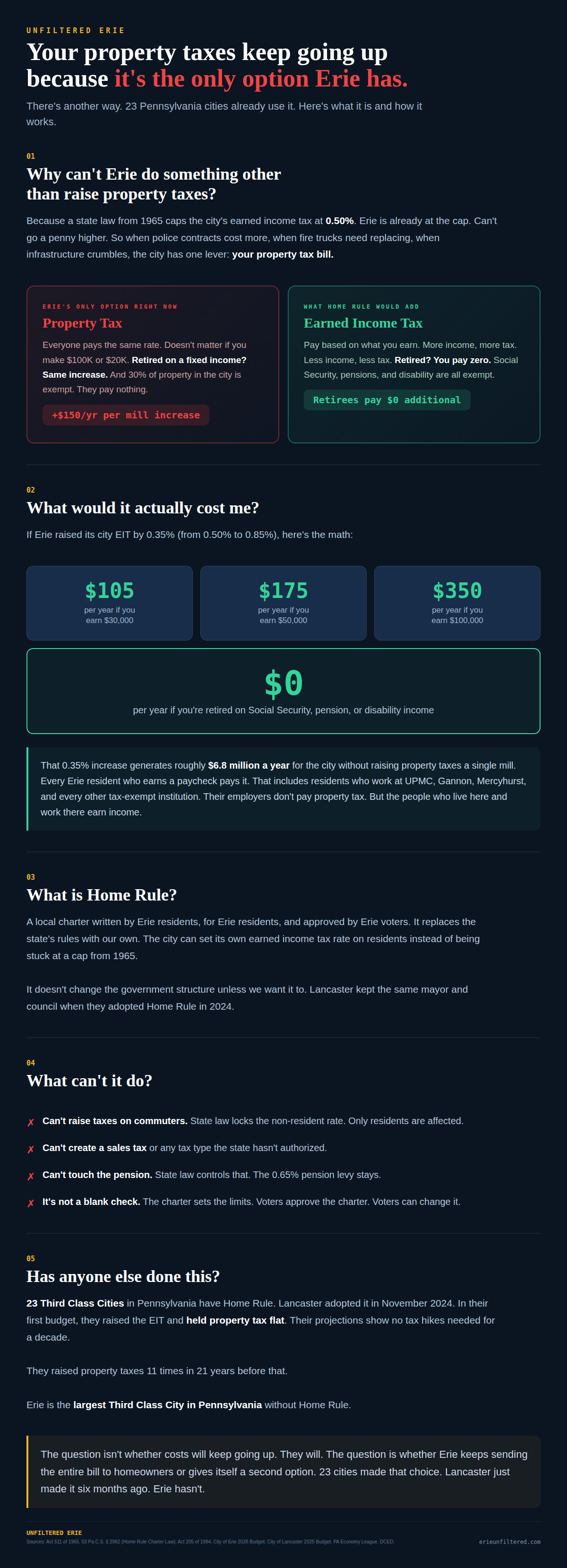
Act 511. 53 Pa.C.S. 2962. City of Erie and Lancaster budgets.
Two Cities. Same Problem. Different Decisions.
Lancaster adopted Home Rule in 2024. Raised EIT, held property tax flat. Reading waited until the state declared them distressed. 13 years under Act 47. Erie is at 0.50% with no ability to change it.
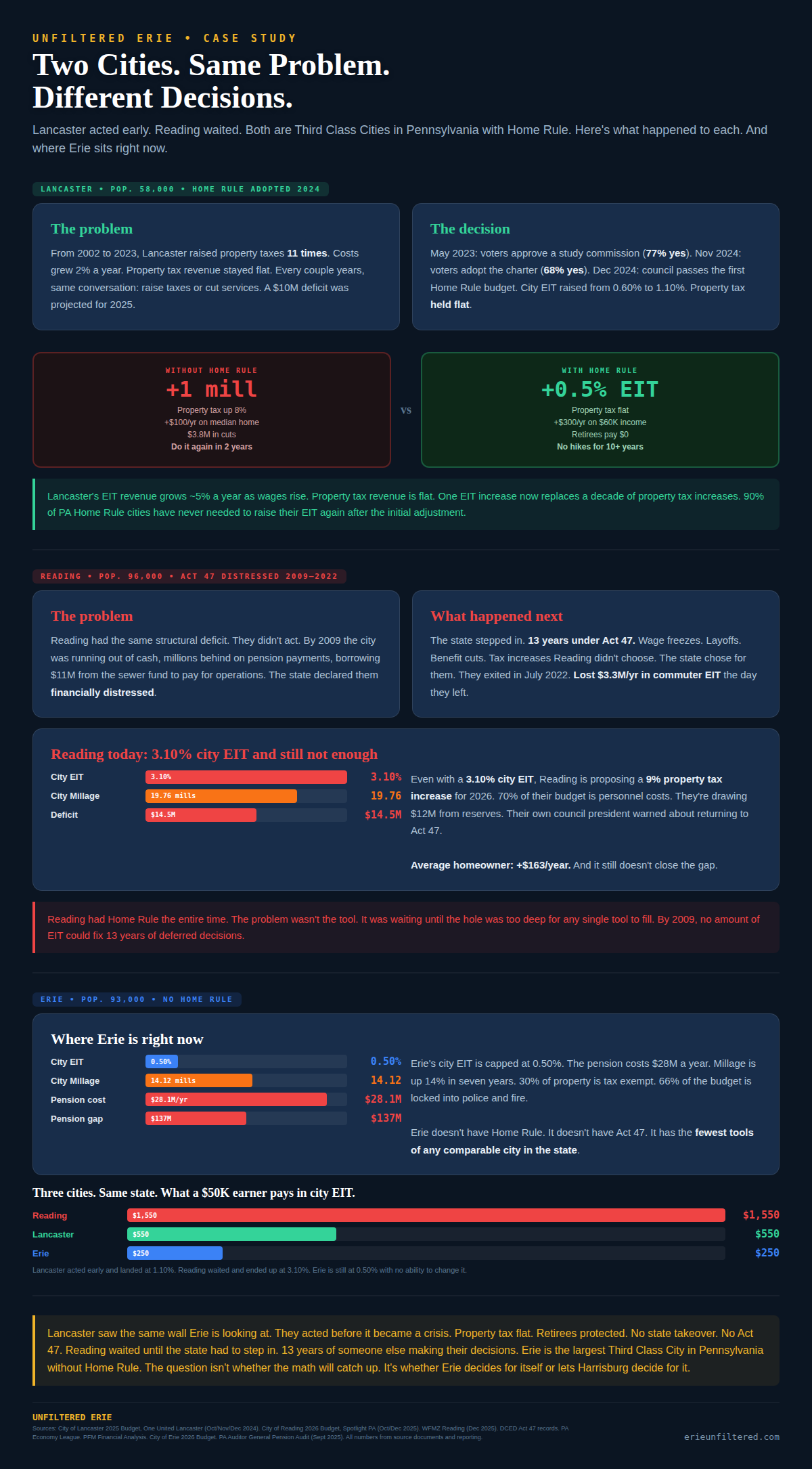
City of Lancaster 2025 Budget. City of Reading 2026 Budget. DCED.
Same State. Same Rules. Different Tools.
Four PA Third Class Cities. Same Act 511 constraints. Only one doesn't have Home Rule. Erie's city EIT is 0.50%. Reading's is 3.10%. A $50K earner pays $250 in city EIT in Erie and $1,550 in Reading.
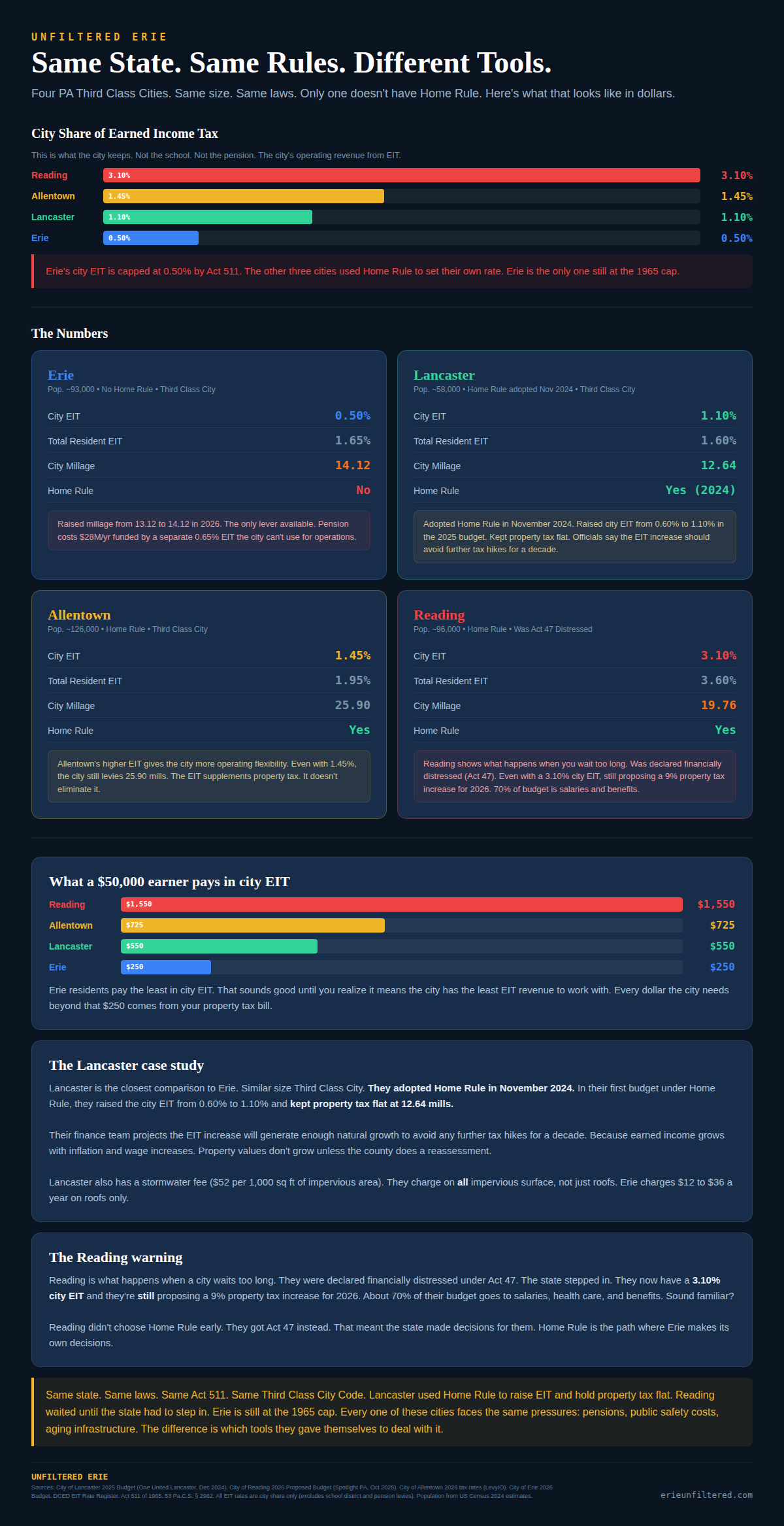
DCED EIT Rate Register. City budgets. US Census.
13,000 Years in 3 Minutes
From the French building a fort on a peninsula in 1753 to the manufacturing boom to the decades of decline. 15 chapters with verified dates, population data, and the turning points that shaped the city.
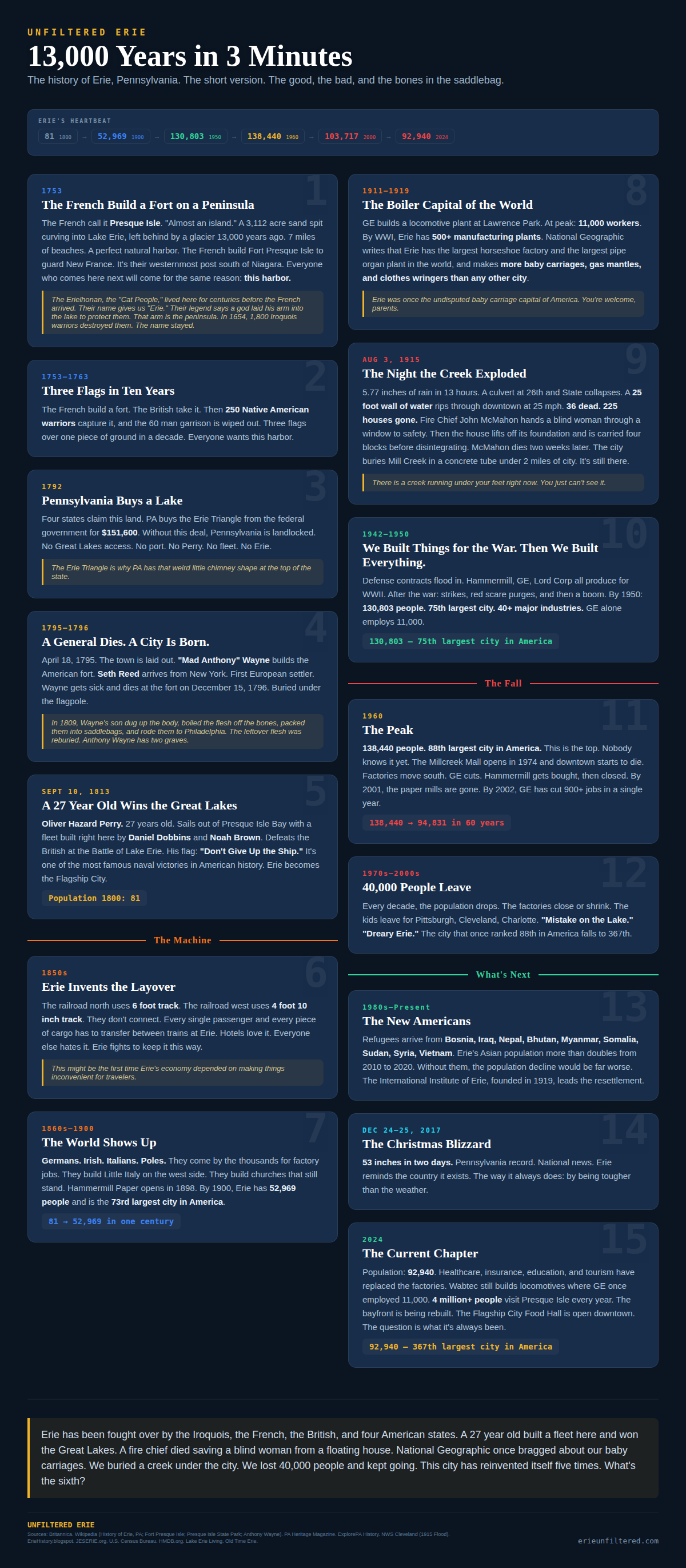
Britannica, PA Heritage, NWS Cleveland, US Census Bureau.